
Qatar Freelance Visa: Is it Legal or not – Best Guide 2026

Qatar doesn’t have a formal “Freelance Visa,” the common practice involves a Qatari sponsor (an individual citizen or a registered company) providing a work visa to a foreign national who intends to work independently. This sponsor acts as the legal entity responsible for the freelancer’s residency and visa status in Qatar, even though they are not the direct employer.

This arrangement allows skilled individuals in fields like IT, design, writing, or consulting to offer their services to various clients on a project basis. It provides the flexibility of freelance work within the legal requirement that all foreign workers have a sponsor in Qatar. The sponsor must be a trustworthy and reliable person which would be helpful in pursuing this path.
What is a Freelance Visa?
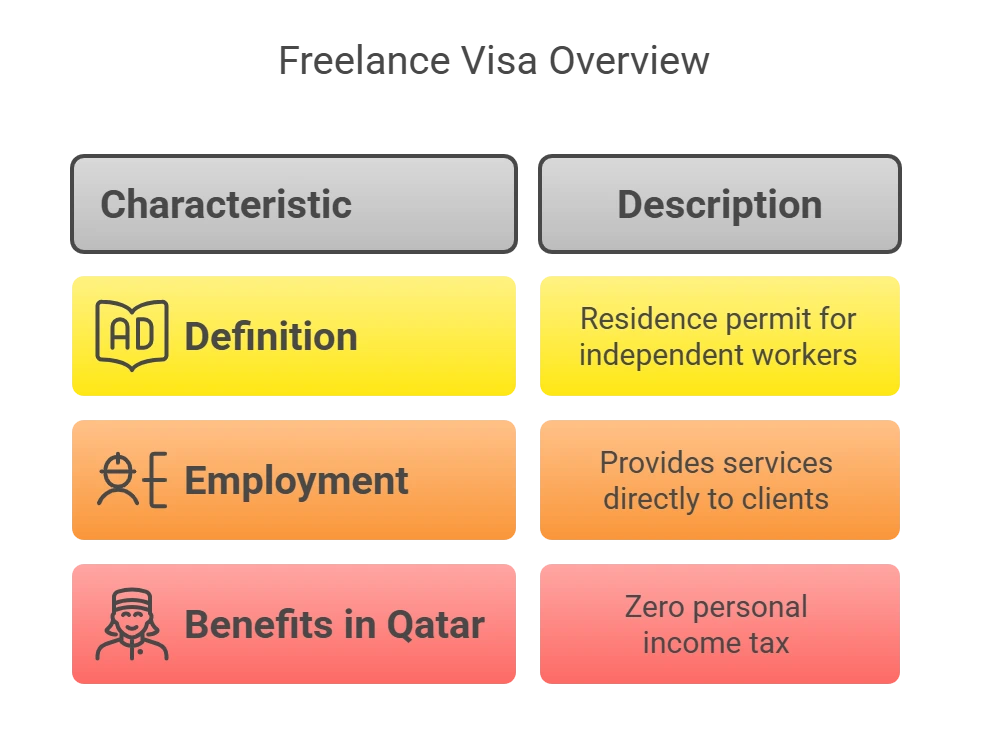
A freelance visa is a type of immigration permit that allows foreign professionals to live and legally work as self-employed individuals in a specific country. Unlike a traditional work visa tied to a specific employer, a freelance visa grants the holder the autonomy to work for multiple clients or run their own business.
Think of it as a permission slip to operate as your own boss in a new country.
Key Aspects of a Freelance Visa:
Independent Work:
The primary feature is the right to engage in freelance work without being sponsored by a single company.
Specific Skills/Sectors:
Many countries offering freelance visas target professionals in specific industries like technology, media, arts, consultancy, and education.
Eligibility Criteria:
Requirements vary significantly by country but often include:
Proof of Funds:
Many countries offering freelance visas target professionals in specific industries like technology, media, arts, consultancy, and education.
Professional Qualifications/Experience:
Providing evidence of skills and experience in the intended field of work (portfolio, client testimonials, etc.).
Business Plan (sometimes):
Some countries may require a business plan outlining the applicant’s intended freelance activities and financial projections.
Health Insurance:
Having valid health insurance coverage in the host country.
Clean Criminal Record:
Providing a police clearance certificate.
Validity and Renewal:
Freelance visas usually have a limited validity period (e.g., 1-3 years) and may be renewable if the holder continues to meet the requirements.
Tax Obligations:
Freelancers are typically responsible for their own taxes in the host country.
Benefits of a Freelance Visa:
Flexibility and Independence:
You have the freedom to choose your clients, projects, and work schedule.
Work-Life Balance:
The autonomy can lead to a better integration of personal and professional life.
Access to New Markets:
It allows you to tap into the economic opportunities of a different country.
Networking:
You can build connections with international clients and other professionals.
Potential Tax Advantages:
Some countries may have favorable tax regimes for freelancers.
Residency Rights:
It provides a legal pathway to live and work in your chosen country.
Examples of Countries Offering Freelance Visas (as of late 2025/early 2026):
Germany:
Offers a “Freiberufler” visa for those in liberal professions and a visa for other self-employed individuals.
Estonia:
Has a Digital Nomad Visa suitable for freelancers who work remotely for clients outside of Estonia.
Spain:
Offers a self-employed visa.
Netherlands:
Has a startup visa that can be relevant for entrepreneurial freelancers.
United Arab Emirates (Dubai & Abu Dhabi):
Offers specific freelance permits within certain free zones and a “Green Visa” for freelancers meeting specific income criteria.
Bulgaria:
Has a specific self-employment visa.
France:
Offers a long-stay visa for self-employed individuals or those in liberal professions.
Important Note:
The specifics of freelance visas, including eligibility, requirements, and application processes, vary significantly from country to country. It’s crucial to research the specific regulations of your desired destination.
Therefore, a freelance visa is a valuable tool for skilled individuals seeking to embrace location independence and pursue their professional endeavors in a foreign country on their own terms.
What is a Qatar Freelance Visa?
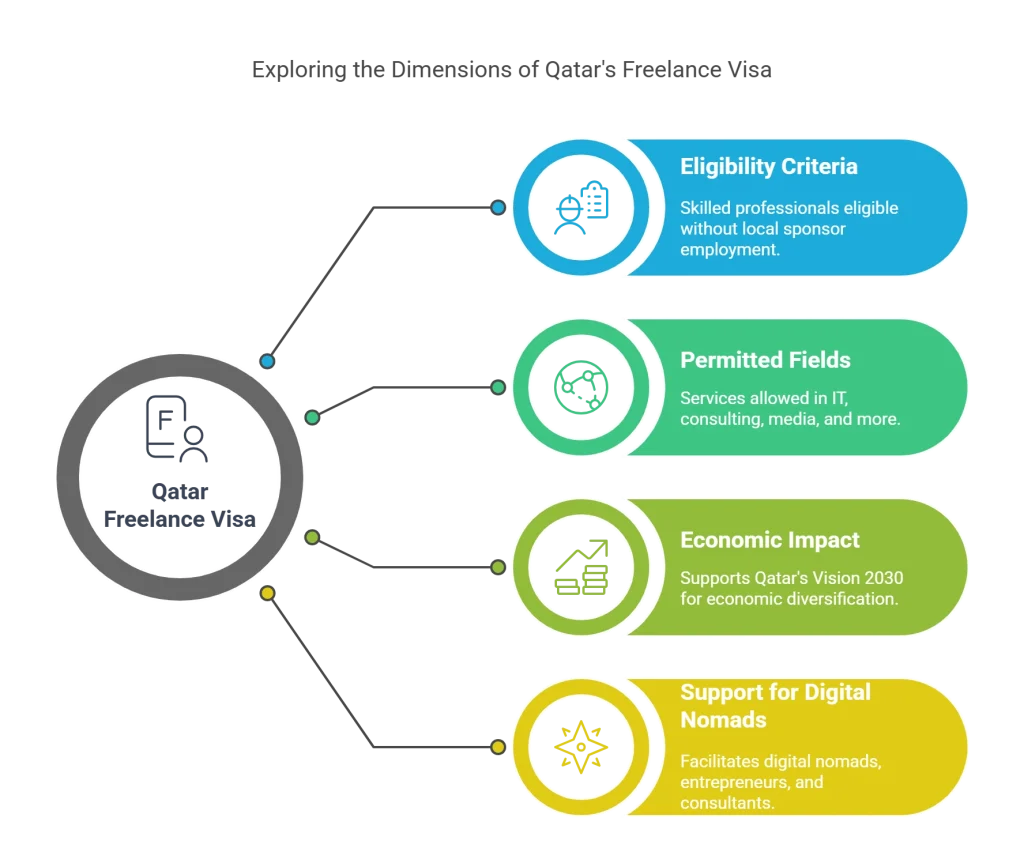
The term “Qatar Freelance Visa” is often used to describe a situation where an individual works independently in Qatar while holding a work visa sponsored by a Qatari citizen or company, without being directly employed by that sponsor. However, it’s important to understand that Qatar does not have an officially recognized visa category specifically designated as a “Freelance Visa” under its labor laws.
Instead, foreign workers in Qatar typically require a sponsoring employer. Working independently under the sponsorship of someone you are not directly employed by exists in a legal gray area and carries potential risks for both the individual and the sponsor.
What is commonly referred to as a “Qatar Freelance Visa” often involves the following (though it’s not a legal visa category):
Sponsorship Requirement:
A foreign national needs a Qatari sponsor (an individual or a company) to obtain a work visa and residency permit.
Working Independently:
Despite having a sponsor, the individual works for various clients or projects without a direct employment contract with their sponsor.
Financial Arrangements:
The “freelancer” might pay the sponsor a fee for holding their visa.
Legal Ambiguity and Risks:
This arrangement is not explicitly legal under Qatari labor law, which generally requires employees to work for their sponsoring entity. Individuals engaging in such arrangements could face penalties.
Legal Alternatives for Independent Professionals in Qatar:
While a direct “freelance visa” doesn’t exist, individuals seeking to work independently in Qatar should explore valid pathways:
Legal Alternatives for Independent Professionals in Qatar:
While a direct “freelance visa” doesn’t exist, individuals seeking to work independently in Qatar should explore valid pathways:
Qatar’s New “Mustaqel Visa” (Future Residency Program):
This new initiative includes categories for Entrepreneurs and Talented Individuals who meet specific criteria and can contribute to Qatar’s economy. This offers a legal route for some independent professionals to obtain residency and work authorization.
Working Through Labor Supply Companies:
These legally registered companies can sponsor foreign workers and contract them out to various businesses for specific projects.
Secondment Agreements:
If employed by a company outside Qatar, a temporary secondment to a Qatari entity might be possible with the necessary approvals.
In conclusion, be wary of the term “Qatar Freelance Visa” as it doesn’t represent an official legal visa category. If you wish to work independently in Qatar, you should investigate the eligibility and application processes for legitimate options like the “Mustaqel Visa” or explore opportunities through labor supply companies, ensuring all arrangements comply with Qatari labor laws.
NOTE: Use the Qatar Visa Check on portal.moi.gov.qa to track and verify the status and validity of your Mustaqel Visa, Qatar’s legal pathway for freelance work.
What is Mustaqel Visa (Independent Visa)?
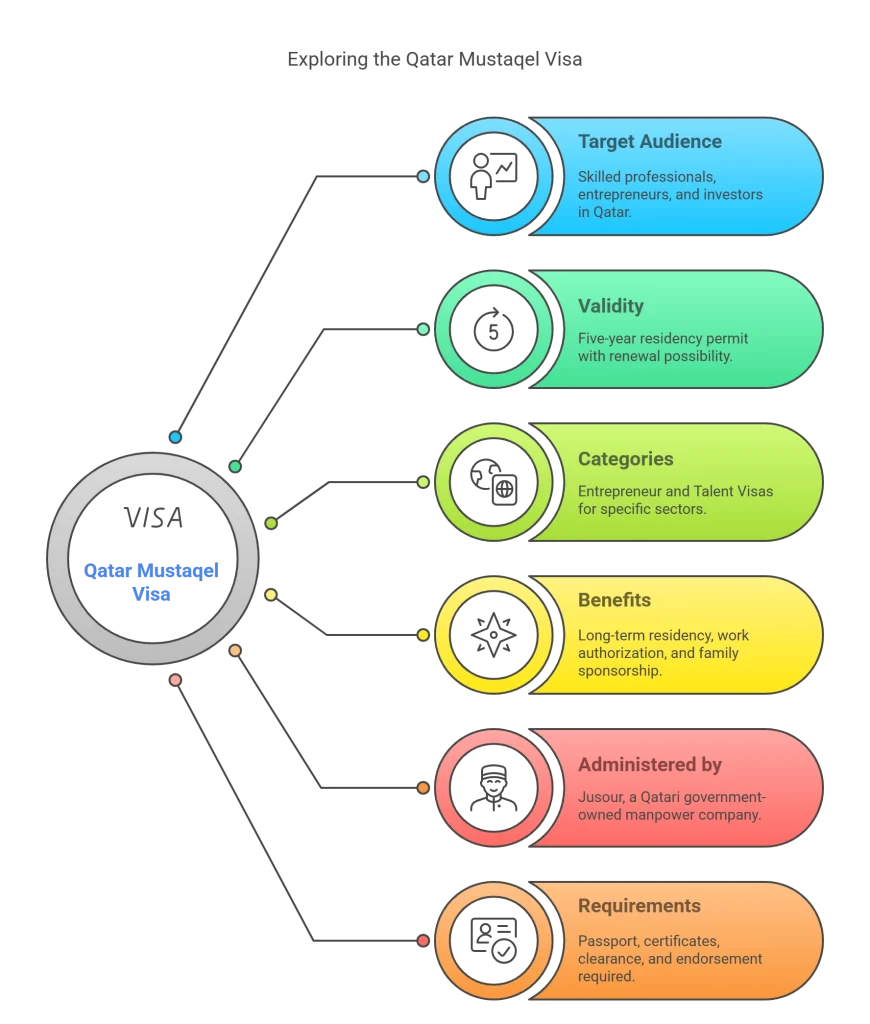
The term “Mustaqel Visa” translates to “Independent Visa” in Arabic. In the context of Qatar, it refers to a new five-year renewable residency permit launched by the Qatari government to attract talented individuals and entrepreneurs to contribute to the country’s economic growth and diversification, aligning with Qatar’s National Vision 2030.
It is not the same as the unofficial and legally ambiguous “freelance visa” that was sometimes discussed in Qatar, which involved working independently under the sponsorship of an entity you weren’t directly employed by. The Mustaqel Visa aims to provide a legal and official pathway for independent professionals and business owners.
Categories For the Qatar Mustaqel Visa According to Eligibility
The Qatar Mustaqel Visa is broadly divided into two categories on the basis of Eligibility.
Talent Visa:
This category targets highly skilled professionals in fields important to Qatar’s national development. Eligible fields include:
- Arts and Entertainment
- Sports
- Information and Communication Technology (ICT)
- Accommodation and Food Services
- Agriculture and Fishing
- Wholesale and Retail Trade
- Transportation and Storage
- Financial Services and Insurance Activities
- Education
- Human Health and Social Services Activities
- Mining and Stone Extraction
- Cultural Talents
- Scientific Research, Development, and Innovation
Entrepreneur Visa:
The eligibility Requirements for the Entrepreneur Visa typically include:
- Present a detailed and viable business plan for a project or investment in Qatar.
- Obtain an endorsement for your business plan from a recognized Qatari business incubator, such as:
- Qatar Science & Technology Park
- Qatar Fintech Hub
- Commit to a minimum investment in your business, typically around QAR 250,000.
Key Features and Benefits of the Mustaqel Visa:
Long-Term Residency:
Grants a five-year residency permit, renewable upon meeting the criteria.
Work Authorization:
Allows the visa holder to live and work in Qatar.
Business Ownership:
Enables entrepreneurs to establish and own businesses in Qatar.
Family Sponsorship:
Holders may be able to sponsor visas for their family members.
Potential for Asset Ownership:
Offers the possibility of owning property in designated areas.
Access to Services:
Provides access to education, healthcare, and other essential services in Qatar.
The Mustaqel Visa is administered by Jusour (Qatar Manpower Solutions Company). The application process generally involves obtaining the necessary endorsements, completing an online application, submitting required documents, paying fees, and undergoing medical and biometric checks in Qatar if approved.
If you are a talented professional or an entrepreneur interested in working independently in Qatar, the Mustaqel Visa presents a significant opportunity. It’s crucial to check the official Jusour website for the most up-to-date eligibility criteria, application procedures, and required documentation.
Is Mustaqel Visa and freelance visa same?
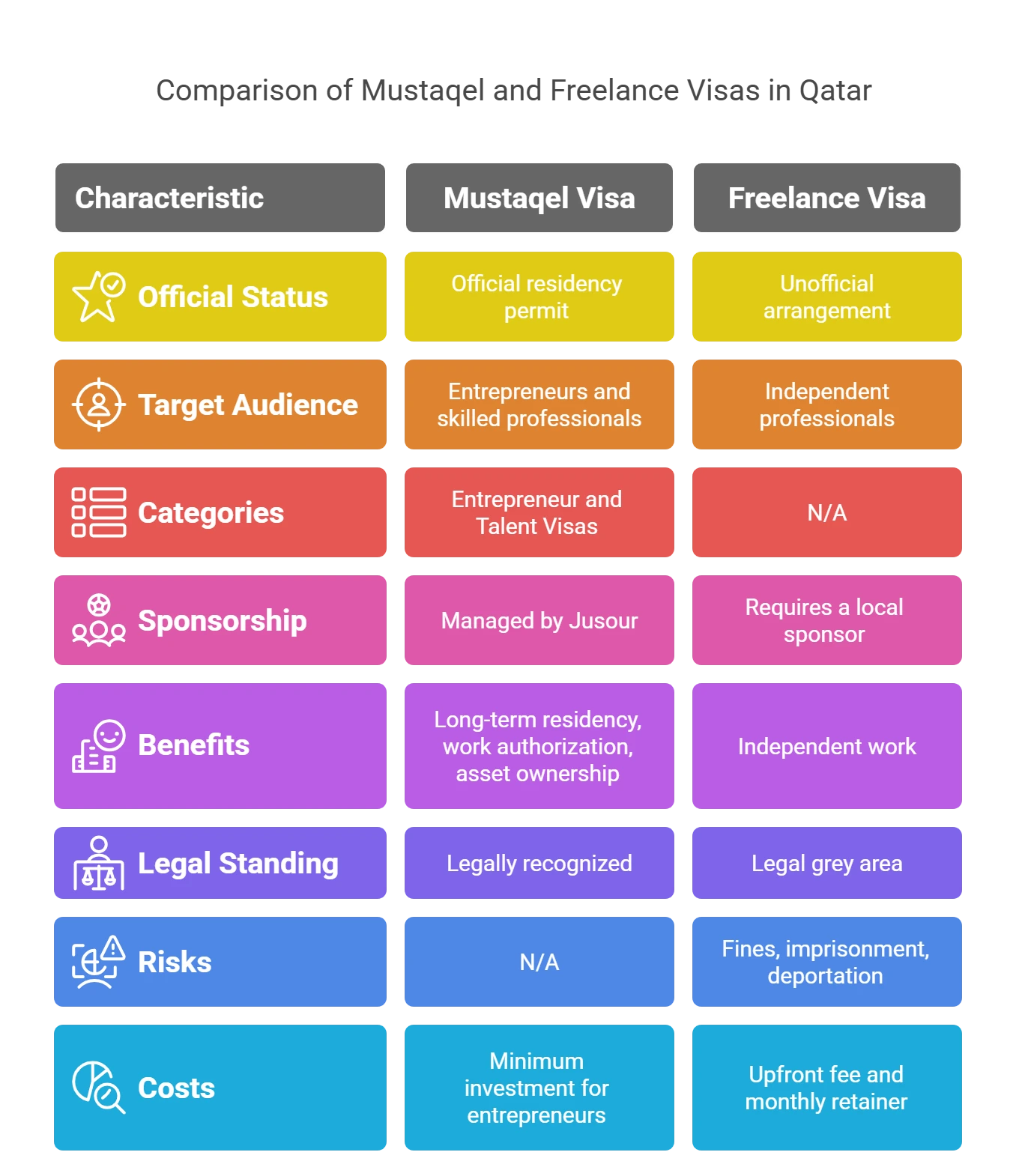
The Mustaqel Visa and a freelance visa (as commonly discussed in the context of Qatar) are not the same thing, although there might be some overlap in their target audience of independent professionals. Here’s a breakdown of the key differences:
Mustaqel Visa (Qatar’s Future Residency Program):
This is a newly introduced, official long-term residency permit by the Qatari government, managed by Jusour (Qatar Manpower Solutions Company). It aims to attract specific categories of individuals to contribute to Qatar’s economy.
There are two categories of Mustaqel Visa.
- Entrepreneur Visa.
- Talent Visa.
Entrepreneur Visa: For business owners with endorsed business plans from recognized Qatari incubators and a minimum investment (currently QAR 250,000 is mentioned in some sources).
Talent Visa: For highly skilled professionals in fields like arts, entertainment, sports, and technology, requiring endorsement from a relevant Qatari entity.
Benefits: Offers long-term residency (initially five years, renewable), work authorization within Qatar, potential for asset ownership, and the ability to sponsor family visas.
Legal Standing: It is a legally recognized residency permit granted by the government.
Freelance Visa (in the context of Qatar):
Unofficial Arrangement: Qatar does not officially offer a specific “freelance visa” under its labor laws. The term “freelance visa” in Qatar often refers to an unofficial arrangement where an individual obtains a work visa through a local sponsor (a Qatari citizen or company) but doesn’t actually work for that sponsor.
Sponsorship-Based: This arrangement relies on the existing sponsorship (Kafala) system, where a sponsor is legally responsible for the visa holder.
Working Independently: The individual on this “freelance visa” typically works independently for various clients without a direct employment contract with their sponsor.
Legal Grey Area and Risks: This practice exists in a legal grey area and carries significant risks for both the freelancer and the sponsor. It can lead to fines, imprisonment, or deportation if discovered by labor authorities, as it technically violates Qatar’s labor laws requiring all work to be tied to an employer-sponsored contract.
Costs: Often involves the visa holder paying the sponsor an upfront fee and potentially a monthly retainer for holding their visa.
Here’s a table summarizing the key differences:
|
Feature |
Mustaqel Visa (Qatar) |
“Freelance Visa” (Qatar – Unofficial) |
|
Official Status |
Officially recognized residency permit. |
Unofficial arrangement, legally ambiguous. |
|
Purpose |
Attract specific talents and entrepreneurs. |
Circumventing direct employment requirements. |
|
Sponsorship |
Self-sponsored (after meeting criteria) |
Requires a local sponsor without direct work |
|
Work Authorization |
Included within the residency permit |
Working independently without official work authorization from the sponsor |
|
Legal Standing |
Legal and protected under immigration laws |
Legally risky, potential for penalties |
|
Target Audience |
Skilled professionals, investors, entrepreneurs |
Individuals seeking independent work |
Is the Qatar Freelance Visa Legal?
The “freelance visa” as it’s commonly discussed in the context of Qatar is not legal under Qatari labor law. Here’s a detailed explanation:
Sponsorship (Kafala) System:
Qatar operates under a sponsorship system (though reforms have been made), where every foreign worker must have a legal sponsor, typically an employer (a Qatari national or company).
Labor Law Restrictions:
Qatari labor laws mandate that foreign employees can only work for their sponsoring entity. Article 15 of Law No. 4 of 2009 explicitly states that it is illegal for sponsors to allow their expatriate employees to work for other entities and for anyone to employ individuals not under their sponsorship.
Unofficial Arrangements:
The term “freelance visa” often refers to an unofficial arrangement where a person obtains a work visa through a sponsor but, in reality, works independently for various clients without a direct employment relationship with that sponsor.
Risks for Individuals:
Engaging in such an arrangement carries significant legal risks for the individual, including: Fines: Individuals working without proper authorization can face substantial fines (up to QAR 50,000).
Imprisonment:
Illegal work can lead to imprisonment (up to 3 years).
Deportation:
Authorities can deport individuals found working in violation of labor laws.
Blacklisting:
Deportation may include a ban on future entry to Qatar.
Exploitation:
Without a proper employment contract, freelancers in such arrangements are vulnerable to non-payment or exploitation with limited legal recourse.
Risks for Sponsors:
Sponsors who facilitate these unofficial “freelance visas” also face legal penalties.
Who is Eligible for a Freelance Visa in Qatar?
The concept of a general “freelance visa” in Qatar that allows individuals to work independently without a specific sponsoring employer is not legally recognized under Qatari labor law.
Therefore, there are no official eligibility criteria for a visa category that doesn’t legally exist.
How to Apply for a Qatar Freelance Visa
As of today, there isn’t an officially recognized “freelance visa” in Qatar in the traditional sense that allows you to work independently without a specific sponsoring employer. The term “freelance visa” in the Qatari context often refers to unofficial arrangements, which are legally ambiguous and carry risks.
However, if you are looking to work independently in Qatar, the relevant visa to explore is the Qatar “Mustaqel Visa” (Independent Visa or Future Residency Program), which has categories for individuals who might work on a freelance basis. The application process is managed by Jusour (Qatar Manpower Solutions Company).
Qatar Freelance Visa Requirements
Before applying, you must gather the following:
- A valid passport (minimum 6 months validity)
- Recent passport-size photographs
- An updated CV or resume
- A professional portfolio or work samples
- Attested educational certificates
- Bank statements (past 3 to 6 months)
- Police clearance certificate
- Health insurance covering your stay
- A clear description of the freelance services you plan to offer
Important: All non-Arabic documents must be translated into Arabic and officially attested.
Finding a Sponsor
For some activities, freelancers must register under a government free zone authority (like QFZA or QFC).
You do not need a private employer sponsor for a freelance permit.
Negotiating Fees
Setup agencies or free zone authorities may charge service fees for company registration, office space, and administrative support.
Signing Paperwork
After approval, you will sign official agreements related to your freelance registration and residence.
Visa Fee
The freelance visa application fee typically ranges between QAR 1,000 and QAR 3,000.
Medical Data
You must undergo a medical fitness examination at an authorized center in Qatar as part of the residence permit process.
Biometric Data
Fingerprinting and biometric data submission are mandatory after your medical test.
Receiving Visa
Once all processes are completed, you will be issued a Freelance Residence Permit (RP) allowing you to legally reside and work in Qatar.
Renewing Visa
The freelance visa must be renewed annually. Proof of ongoing freelance activity and income will be required for renewal.
Registration, Fees, and Final Steps
It seems you’re asking about the steps, fees, and final stages for a Qatar Freelance Visa. However, it’s crucial to reiterate that Qatar does not have an officially recognized “Freelance Visa” in the traditional sense.
The term “freelance visa” in Qatar often refers to unofficial arrangements, which are legally risky. If you’re looking to work independently in Qatar legally, the relevant avenue is the Qatar “Mustaqel Visa” (Independent Visa or Future Residency Program).
Here’s a breakdown of the registration, fees, and final steps based on the Mustaqel Visa, as this is the legitimate pathway for independent professionals and entrepreneurs:
Registration and Application Process (for Mustaqel Visa):
Eligibility Assessment:
Determine if you qualify under the Talent Visa or Entrepreneur Visa category. Review the specific requirements for each on the official Jusour website.
Required Documents:
Prepare all necessary documents, which typically include:
- Valid passport
- Passport-sized photographs
- Educational and professional certificates (must be attested if issued abroad)
- Police Clearance Certificate
NOTE: For Entrepreneur Visa: Business plan, proof of funds, endorsement from a Qatari business incubator.
For Talent Visa: Evidence of talent, endorsement from a relevant Qatari entity OR job offer OR proof of sufficient funds.
Online Registration and Application:
- Visit the official Jusour websites:
- https://mustaqel.jusour.qa/
- https://jusour.qa/
- Create an account and register on the portal.
- Select the appropriate visa category (Talent or Entrepreneur).
- Fill out the online application form accurately.
- Upload all required documents in the specified format.
Fees for Mustaqel Visa:
Entrepreneur Visa: The administrative fee is QAR 5,000 (approximately USD 1,374).
Talent Visa: The administrative fee is QAR 4,000 (approximately USD 1,099).
These fees are typically paid online during the application process.
The administrative fee is often mentioned as refundable if the application is rejected (excluding any processing fees).
Final Steps (If Application is Approved):
Receive Pre-Approval: If your online application is successful, you will likely receive an electronic pre-approval.
Travel to Qatar (if applying from outside): Present the pre-approval at the immigration counter upon arrival to get an entry visa endorsed on your passport.
Medical Examination: Undergo a medical examination at an approved health center in Qatar.
Biometric Registration: Provide your biometric data (fingerprints and photo) at the relevant authorities.
Obtain Qatar ID (Residence Permit): Once all procedures are completed, you will receive your Qatar ID card, which serves as your residence permit.
Important Considerations:
Official Sources: Always rely on the official Jusour website for the most accurate and up-to-date information and procedures.
Endorsements: Securing the required endorsement from a Qatari business incubator (for entrepreneurs) or a relevant government entity (for talented individuals) is a crucial early step.
Fees: Be prepared to pay the application fees online.
No Guarantee: Approval is not guaranteed even if you meet the eligibility criteria.
Processing Time: The processing time can vary.
Regarding the Unofficial “Freelance Visa”:
If you encounter information about fees (often cited as an upfront fee of QAR 5,000-10,000 and monthly payments to a sponsor of QAR 250-500) and registration for a general “Qatar Freelance Visa,” please be aware that these describe unofficial and potentially illegal arrangements. Engaging in such arrangements carries significant legal risks.
In summary, focus on the official Mustaqel Visa program if you are seeking a legal way to work independently in Qatar as a talented professional or entrepreneur. The registration, fees, and final steps outlined above pertain to this official visa program.
Common Problems Freelance Visa Holders Face in Qatar
Individuals who operate as freelance workers in Qatar, often under unofficial arrangements as there isn’t a standard “freelance visa,” can face several common problems:
Legal Issues and Risks:
Illegal Employment Status:
The primary and most significant problem is that working independently without a direct sponsoring employer is often against Qatar’s labor laws. This can lead to: Fines: Individuals working without proper authorization can face substantial fines.
Imprisonment:
In some cases, illegal work can lead to imprisonment.
Deportation:
Authorities can deport individuals found working in violation of labor laws.
Blacklisting:
Deportation may include a ban on future entry to Qatar.
No Legal Protection:
As these arrangements are outside the formal legal framework, freelancers often lack the protections afforded to legally employed workers under Qatari labor law. This includes issues related to contracts, working hours, holidays, and end-of-service benefits.
Sponsor-Related Problems (in unofficial arrangements):
Unreliable Sponsors:
Individuals sponsoring “freelancers” may be primarily interested in financial gain from visa fees and may not provide necessary support for visa renewals, family visas, or other essential processes.
Financial Exploitation:
Sponsors might demand exorbitant fees for issuing or renewing visas, providing No Objection Certificates (NOCs) for job changes (if possible), or other administrative tasks.
Unreliable Sponsors:
Individuals sponsoring “freelancers” may be primarily interested in financial gain from visa fees and may not provide necessary support for visa renewals, family visas, or other essential processes.
Financial Exploitation:
Sponsors might demand exorbitant fees for issuing or renewing visas, providing No Objection Certificates (NOCs) for job changes (if possible), or other administrative tasks.
Sponsor Disappearance:
If a sponsor faces legal issues or closes their business, the freelancer’s legal status in Qatar becomes precarious.
Difficulty in Changing Jobs:
Even if a freelancer finds a formal employment opportunity, their current sponsor might demand a large sum of money to release them.
Financial Instability and Exploitation:
Payment Issues:
Without formal contracts or legal safeguards, freelancers might face delays or non-payment from clients. They have limited legal recourse in such situations.
High Visa Costs:
Upfront and recurring “sponsorship” fees can be very high, significantly reducing the freelancer’s earnings.
Lack of Benefits:
Unlike regular employees, freelancers typically do not receive benefits such as health insurance, housing allowances, or end-of-service gratuity.
Practical and Logistical Challenges:
Qatar ID and Visa Renewals:
Freelancers are dependent on their sponsors for the renewal of their Qatar IDs and visas. Uncooperative sponsors can create significant problems.
Bringing Family to Qatar:
Upfront and recurring “sponsorship” fees can Sponsoring family visas can be challenging or impossible under unofficial freelance arrangements.be very high, significantly reducing the freelancer’s earnings.
Opening Bank Accounts:
Unlike regular employees, freelancers typically do not receive benefits such as health insurance, housing allowances, or end-of-service gratuity.
The Emergence of the Mustaqel Visa:
It’s important to note that Qatar has introduced the Mustaqel Visa (Independent Visa), which aims to provide a legal pathway for certain independent professionals (Talent Visa category) and entrepreneurs (Entrepreneur Visa category). If eligible for this new visa, many of the problems associated with unofficial “freelance visas” could be avoided. This visa grants the holder independent residency and work authorization without being tied to a traditional employer-sponsor relationship.
Therefore, for individuals seeking to work independently in Qatar, exploring the Mustaqel Visa is crucial to ensure legal compliance and avoid the common problems faced by those in unofficial “freelance” arrangements.
How to Work Legally as a Freelancer in Qatar
To work legally as a freelancer in Qatar, you should focus on the Qatar “Mustaqel Visa” (Independent Visa or Future Residency Program). This is the official route introduced by the Qatari government to attract talented individuals and entrepreneurs who may work independently.
Here’s how to work legally as a freelancer in Qatar through the Mustaqel Visa:
Determine Your Eligibility for the Mustaqel Visa:
Talent Visa:
If you are a highly skilled professional in fields like arts, entertainment, sports, technology, education, or research, and can obtain an endorsement from a relevant Qatari government authority. You might also qualify with a job offer or proof of sufficient funds.
Entrepreneur Visa:
If you have a viable business plan for a startup or SME in Qatar, endorsed by a recognized Qatari business incubator, and are willing to make the minimum required investment (around QAR 250,000).
Apply for the Mustaqel Visa:
Registration and Application:
Visit the official Jusour website (https://jusour.qa/) and register. Complete the online application form for the Talent or Entrepreneur Visa, providing all required information.
Document Submission:
Upload all necessary documents, which include your passport, educational and professional certificates, police clearance, and specific documents related to your chosen category (endorsement letters, business plan, proof of funds, etc.). Ensure documents from outside Qatar are properly attested.
Fee Payment:
Pay the applicable administrative fee online (QAR 4,000 for Talent Visa and QAR 5,000 for Entrepreneur Visa).
Complete Final Steps Upon Approval:
Pre-Approval:
If your application is approved, you’ll receive a pre-approval.
Travel to Qatar:
If you applied from outside Qatar, travel to Qatar using the pre-approval.
Medical Examination and Biometrics:
Undergo a medical check-up and provide your biometric data in Qatar.
Qatar ID:
Obtain your Qatar ID (Residence Permit), which will allow you to live and work in Qatar independently under the Mustaqel Visa.
Key Points to Remember:
- No Traditional “Freelance Visa”: Qatar’s labor law does not provide a standard visa category for general freelance work without a sponsor. The Mustaqel Visa is the closest legal option for freelancers.
- Focus on the Mustaqel Visa: To work legally as a freelancer, understand the eligibility and application process for the Talent or Entrepreneur categories under the Mustaqel Visa.
- Avoid Unofficial Arrangements: Engaging in freelance work through unofficial sponsorships carries serious legal risks. The Mustaqel Visa is the legitimate alternative.
- Use Official Information Sources: Always refer to the official Jusour website (https://jusour.qa/) for the most accurate and up-to-date details.
- Legal Path to Independence: Following Mustaqel Visa guidelines allows you to legally establish yourself as an independent professional in Qatar.
Qatar Labour Law: Article 15 (Law No. 4 of 2009)
According to Article 15 of Qatar’s Labour Law (Law No. 4 of 2009), employees are generally not allowed to change employers without official approval. However, this does not apply to freelancers who are operating under a freelance residence permit. Once you are registered as an independent professional, you are exempt from employer-transfer restrictions and can work independently in your registered field.
Penalties for the Individual Working Illegally in Qatar
Working illegally in Qatar carries significant penalties for both the individual working without proper authorization and the employer who hires them. Here’s a breakdown of the potential consequences:
Imprisonment and Fines
- Imprisonment: Up to three years for individuals found working illegally.
- Fines: Up to QAR 50,000 (approximately USD 13,700).
- Both Imprisonment and Fine: Courts may impose both penalties simultaneously.
Deportation and Blacklisting
- Deportation: Likely after serving a sentence or paying the fine.
- Blacklisting: May include a ban on future entry to Qatar.
Repeat Offenses
- Stricter Penalties:
- Mandatory jail sentence: At least 15 days and up to three years.
- Increased fines: Ranging from QAR 20,000 to QAR 100,000.
Penalties for the Employer Hiring Illegal Workers
Recruitment and Hiring Restrictions
- Recruitment Ban: Blacklisting and a minimum two-year ban from recruiting new employees.
- For individuals, the ban applies only to them, not necessarily their other companies.
Financial and Criminal Penalties
- Fines:
- Up to QAR 50,000 per illegal worker for the first offense.
- Repeat offenses: Fines can increase up to QAR 100,000.
- Imprisonment: Up to three years in severe or repeat cases.
Additional Penalties for Expatriate Owners
- Deportation: Expatriate business owners may face deportation and a lifetime entry ban.
Lending of Employees
- One-Year Recruitment Ban: Imposed on companies that allow their employees to work illegally for other entities without a legal secondment contract.
What Constitutes Working Illegally
Unauthorized Work Situations
- Working for another employer without proper authorization or secondment permit.
- Working without a valid residence or work visa.
- Engaging in activities not permitted under your current visa category.
- Overstaying in Qatar without renewing or updating your visa.
Enforcement and Legal Compliance
- The Ministry of Interior and the Ministry of Labour conduct inspections and enforce penalties.
- The goal is to protect workers’ rights and prevent exploitation.
- Individuals should ensure they:
- Hold a valid work visa,
- Work only for their legal sponsor, or
- Have an approved secondment agreement in place.
Legal Alternative: The Mustaqel Visa
- Offers a lawful path for independent professionals.
- Should be considered instead of engaging in illegal freelance or employment practices.
Tips for Applying for a Freelance Visa in Qatar
Since there is no officially recognized “Freelance Visa” in Qatar, the best legal route for independent work is through the Mustaqel Visa, specifically under the Talent Visa or Entrepreneur Visa categories.
Tips for Applying for the Qatar Mustaqel Visa
Understand the Eligibility Thoroughly
- Talent Visa:
- Review the list of eligible fields.
- Understand the endorsement requirements from Qatari authorities.
- Research which government entities can endorse your expertise.
- Entrepreneur Visa:
- Evaluate if your business idea is viable in the Qatari market.
- Ensure it aligns with Qatar’s economic development goals.
- Identify and understand the role of recognized Qatari business incubators in the endorsement process.
Prepare High-Quality Documents
- Accuracy: Ensure all submitted details are correct and consistent.
- Completeness: Include all required documents listed on the Jusour website.
- Attestation:
- Educational/professional certificates issued outside Qatar must be attested by the relevant authorities and possibly the Qatari embassy.
- Translation: Provide certified translations if documents are not in Arabic or English.
- Clarity and Presentation:
- Documents should be clear, organized, and easy to review.
- Entrepreneurs should have a strong, detailed business plan.
- Talent applicants should include a portfolio or documented achievements.
Focus on the Endorsement (Crucial Step)
- Research Endorsers:
- Build Connections:
- Where possible, network with individuals or institutions in Qatar who understand the endorsement process.
- Tailor Your Pitch:
- Clearly show how your skills or business will contribute to Qatar’s economy and national vision.
Demonstrate Financial Stability
- Entrepreneur Visa:
- Show clear proof of financial capacity to invest the required capital in your business.
- Talent Visa (without job offer):
- Provide evidence of personal funds, often around QAR 36,500, to support yourself in Qatar.
Follow the Official Process
- Use the Official Website:
- Apply only via Jusour.qa.
- Read Instructions Carefully:
- Follow all application guidelines and document requirements.
- Be Aware of Deadlines:
- Track any submission windows or closing dates for applications.
Prepare for Interviews or Further Requests
- Be ready for possible interviews or requests for additional documents.
- Respond promptly and professionally if contacted.
Be Patient
- Processing times can vary.
- Avoid excessive follow-up unless requested patience is key.
Seek Professional Guidance (If Needed)
- Consider hiring a reputable immigration consultant or legal advisor familiar with the Mustaqel Visa if you find the process challenging.
Final Words
While the term “Qatar Freelance Visa” is often used informally, it’s important to recognize that Qatar does not currently offer a legally defined freelance visa. Instead, professionals who wish to work independently in Qatar must explore alternative legal pathways such as the Mustaqel Visa, which is specifically designed for talented individuals and entrepreneurs. Whether you’re a remote worker, creative professional, or business founder, Qatar’s evolving immigration policies are creating real opportunities—as long as you navigate them through the correct legal channels. Always consult official sources and avoid informal arrangements that could jeopardize your status or livelihood. Qatar is opening its doors to independent professionals, but success starts with staying informed and compliant.


